
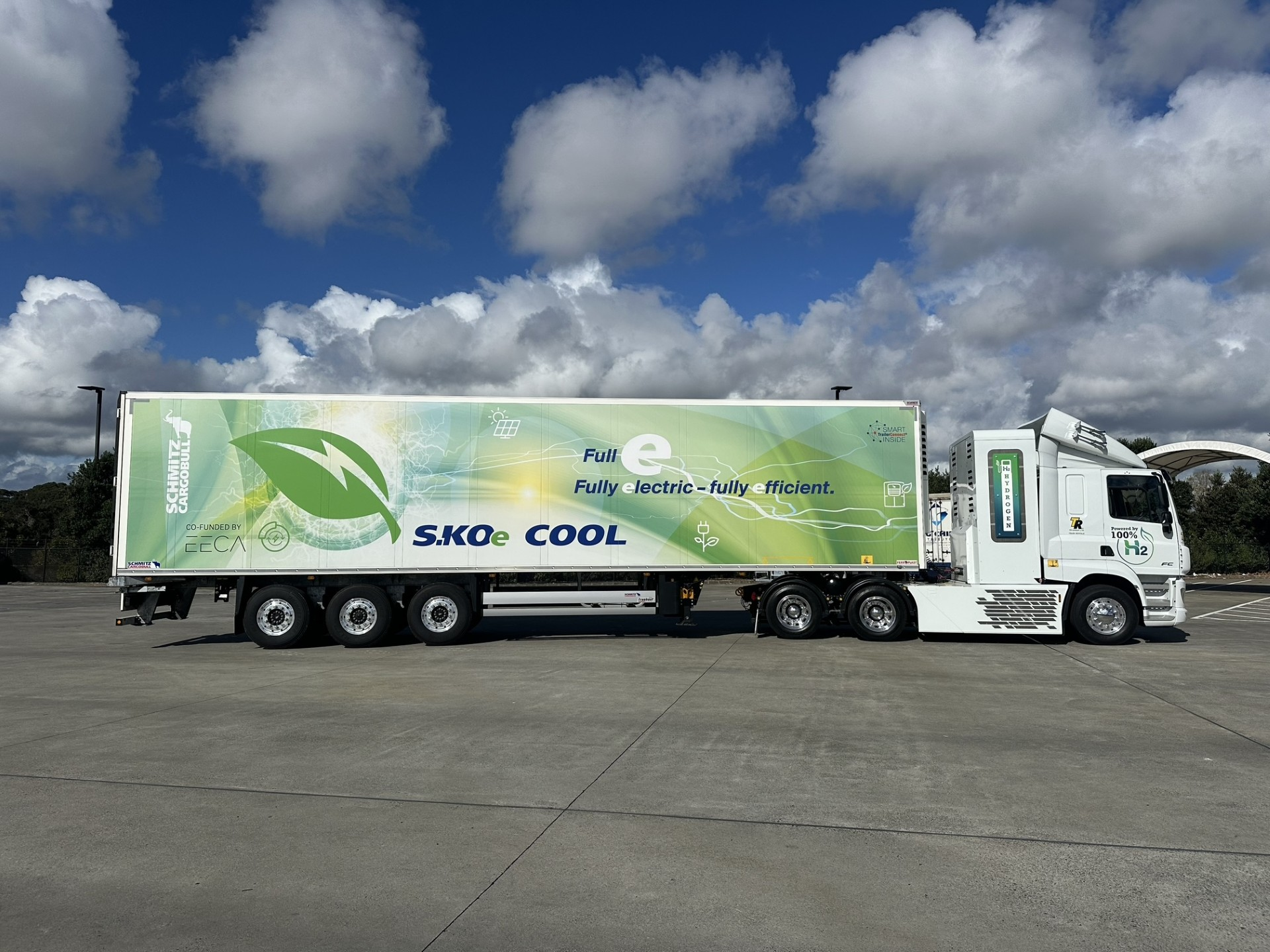
Fruehauf NZ Ltd has launched New Zealand’s first fully electric semi-trailer — the Schmitz Cargobull S.KOe COOL. Here’s how it works and why it matters.
Every refrigerated trailer on New Zealand roads is quietly running two engines. There’s the one in the truck up front — and a second one, a diesel generator, hidden away just to keep the fridge unit running. It’s easy to forget it’s there, right up until it needs fuel, a service, or a roadside repair.
In August 2024, that changed. Fruehauf launched the Schmitz Cargobull S.KOe COOL — New Zealand’s first fully electric semi-trailer, and the first in the country to remove that second diesel engine altogether.
How it actually works
The idea is simpler than it sounds. Instead of a diesel generator, the S.KOe COOL runs its refrigeration unit on a 32kWh lithium iron phosphate battery, mounted where the diesel tank used to sit on the landing gear. An electric e-axle on the trailer tops that battery up while the truck is driving — particularly above 60km/h, and every time it brakes — so the trailer is largely recharging itself on the road.
The refrigeration circuit itself is the same one used in Schmitz Cargobull’s conventional units, delivering up to 15,800W of cooling and 10,500W of heating. That matters more than it might seem: this isn’t a scaled-down system asking operators to compromise on performance for the sake of going electric. It’s the same cooling power, just without the diesel.
Why cold-chain operators are paying attention
For fleet and transport managers running refrigerated freight — supermarket distribution, dairy, meat, produce — three things tend to stand out:
• Fewer things to break down. Removing the diesel generator removes an entire maintenance and fuel line item, and one less mechanical point of failure on the road.
• Quieter deliveries. With near-silent operation, the S.KOe COOL can make deliveries into noise-restricted zones and CBD stores at night — a genuine scheduling advantage in markets where daytime access windows are tight.
• A real answer on emissions. More operators are being asked by their retail and food-manufacturing customers about supply chain emissions. A fully electric reefer trailer already in operation is a very different conversation than a five-year sustainability plan on paper.
Proven, not experimental
It’s a fair question to ask: is this actually ready, or is it a pilot dressed up as a product? The answer is in the credentials. Schmitz Cargobull is the first manufacturer to receive European type-approval for this generator-axle electric refrigeration technology, and the S.KOe COOL won the European Transport Sustainability Award in 2024. It’s also been tested in a climatic wind tunnel across temperatures from -30°C to +50°C, plus humidity, sun, rain, snow, and ice — not just in ideal conditions.
Just as importantly for operators: handling is identical to a conventional trailer. There’s no new licence, no retraining for drivers, and no unfamiliar system for workshop teams to learn from scratch.
Where it fits
The S.KOe COOL isn’t a one-size-fits-all answer. The version with the e-axle suits longer routes at sustained highway speed, where there’s plenty of driving time to keep the battery topped up. For shorter, stop-start distribution work, it’s also available without the e-axle — lighter, and lower cost, for operators who don’t need the continuous recharging.
Either way, it’s a way to start decarbonising the cold chain without replacing an entire fleet or investing in new charging infrastructure — the trailer can be towed by an existing diesel tractor today.
Want to see it for yourself?
Fruehauf is currently inviting New Zealand operators to register for an opportunity to trial the S.KOe COOL. If your fleet is facing rising diesel and maintenance costs, delivery-window restrictions, or customer pressure on emissions, it’s worth seeing what New Zealand’s first fully electric semi-trailer can actually do.